
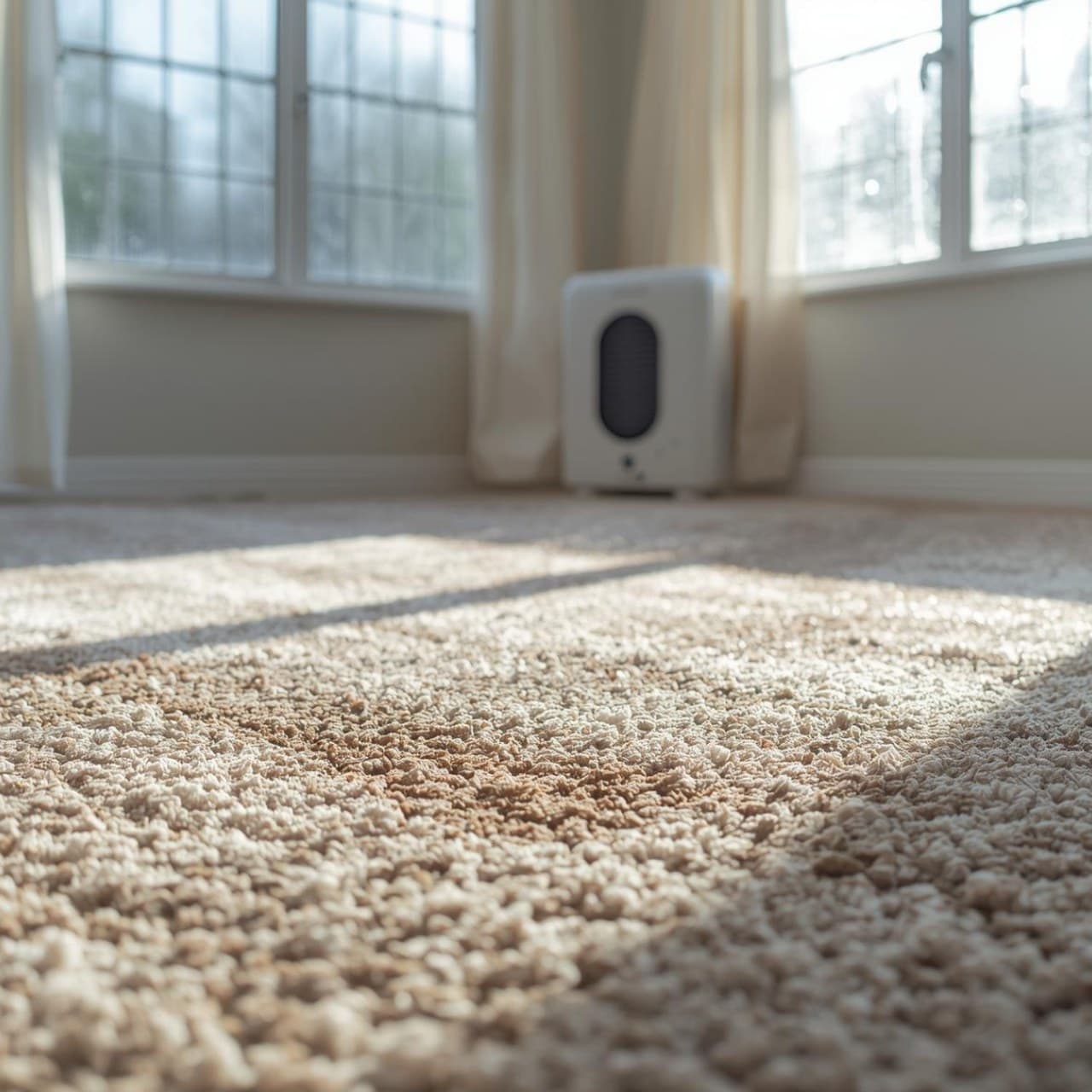
If you have lived in Carrollton for more than a season, you know the dust. It settles on the entry table a day after you wipe it, hazes the top of the ceiling fan, and works its way into every corner no matter how tightly the windows are shut. Most of us think of it as a cleaning nuisance, something for the duster and the Swiffer. What far fewer people realize is that the same fine grit is inside the carpet, down at the base of the fibers, and it is slowly wearing the floor out from within. To understand why, it helps to look at the ground Carrollton is built on.
The trouble with our clay
Northwest Dallas County sits on the kind of dense, shrink-swell clay soil that gives North Texas its reputation for cracked driveways and shifting foundations. When it is wet it swells; when it dries it contracts and cracks, and in the process it throws off an incredibly fine, mineral-heavy dust. During a dry stretch in July or August, that dust is everywhere. It rides in on the breeze, hitches onto your shoes, clings to the dog after a walk around Josey Ranch Lake, and drifts through the door every time someone comes and goes along Belt Line Road.
Once inside, it does not stay on hard surfaces where you can see and wipe it. Gravity and foot traffic pull it down into the carpet, and because the particles are so fine they sift past the tips of the fibers and settle at the base, right against the backing. That is the part of the carpet you never see and rarely reach, and it is exactly where the damage happens.
Why grit is worse than it looks
Here is the mechanism that makes soil so destructive. Those clay and mineral particles are not soft. Under a microscope they are hard and jagged, more like tiny shards of glass than like flour. Every time you walk across the carpet, your weight presses the fibers down against that embedded grit and drags them a fraction across it. Fiber grinds against sharp particle, thousands of times a day, in the paths you use most.
Over months and years, that constant micro-abrasion cuts and frays the individual fibers. It is the same idea as sandpaper, just slower. This is why the traffic lanes, the hallway, the path from the couch to the kitchen, the stairs, go dull and matted and worn long before the carpet under the furniture shows any age at all. People assume those lanes are simply dirty, and they are, but they are also physically abraded. Once the fiber is cut, no amount of cleaning brings the plushness back. The wear is permanent.
The dust does one more thing while it is down there. It holds odor and it feeds the allergy load. In a home with cedar and ragweed already pushing pollen through the air for much of the year, a carpet packed with fine soil becomes a reservoir that releases a little of that irritant load every time someone walks across the room. For a Carrollton family with anyone prone to allergies or asthma, the floor is quietly working against them.
Why vacuuming only gets you so far
A good vacuum, run often, is genuinely important, and it pulls up the loose dirt and hair sitting near the surface. But a home vacuum is not built to extract the fine, packed grit wedged down at the base of the fibers and against the backing. That deep layer is where the abrasive damage is happening, and it is precisely the layer a household machine cannot reach. So you can vacuum diligently and still be walking on a bed of embedded soil that is filing your carpet down a little more every day.
This is the case for a periodic professional cleaning, and not as a luxury. Our carpet cleaning service is built to lift out the deep grit a vacuum leaves behind. The low-moisture, carbonating method works dirt up off the fibers from the base, so we are pulling out the abrasive soil that is actually doing the wearing, not just freshening the tips you can see. Getting that grit out is one of the most effective things you can do to make a carpet last, because every particle you remove is one that is no longer sanding the fiber with every footstep.
Practical ways to keep the grit out
You cannot stop North Texas dust, but you can keep a lot of it off the carpet:
- Put down real doormats at every entry, and make it a habit to wipe or, better, leave shoes at the door. A huge share of the soil in any home walks in on the soles of shoes.
- Vacuum the traffic lanes more often than the rest of the house, at least twice a week. Those paths take the most abuse and hold the most grit.
- Change the HVAC filter on schedule, especially through the dusty summer months. Cleaner air means less airborne dust settling into the fibers in the first place.
- Get the carpet professionally cleaned once or twice a year, and more often for the high-traffic zones, to pull the deep grit before it can wear the fiber down.
None of this is exotic. It is just aimed at the real enemy, which is not the visible dust on the table but the invisible grit ground into the floor. Deal with that and a Carrollton carpet will look better and last years longer.
If your traffic lanes are going flat and dull ahead of their time, embedded North Texas soil is almost certainly the reason. Call Safe-Dry® Carpet Cleaning of Carrollton at 469-521-9367 and we will lift the deep grit your vacuum leaves behind, with your carpet clean and dry in about an hour.